On August 25, Discover Innovation and Career Opportunities in Guangzhou and Huangpu Info Session was successfully hosted by the NUS (Guangzhou) Research Translation and Innovation Institute (NUS GRTII) at the NUS University Hall Auditorium.
The event brought together over 100 distinguished academics and researchers from the National University of Singapore, including professors, research fellows, postdoctoral scholars, and doctoral and master's students, to explore career pathways and entrepreneurial ventures in the core region of the Guangdong-Hong Kong-Macao Greater Bay Area. Designed to provide NUS faculty and students with deeper insights into Guangzhou and Huangpu’s talent incentives and development opportunities, the info session leverages the Institute’s world-class translational research capabilities to attract high-caliber international talent to pursue careers and launch enterprises in Guangzhou.
Opening Remarks:
Exploring Talent Synergies in the Greater Bay Area
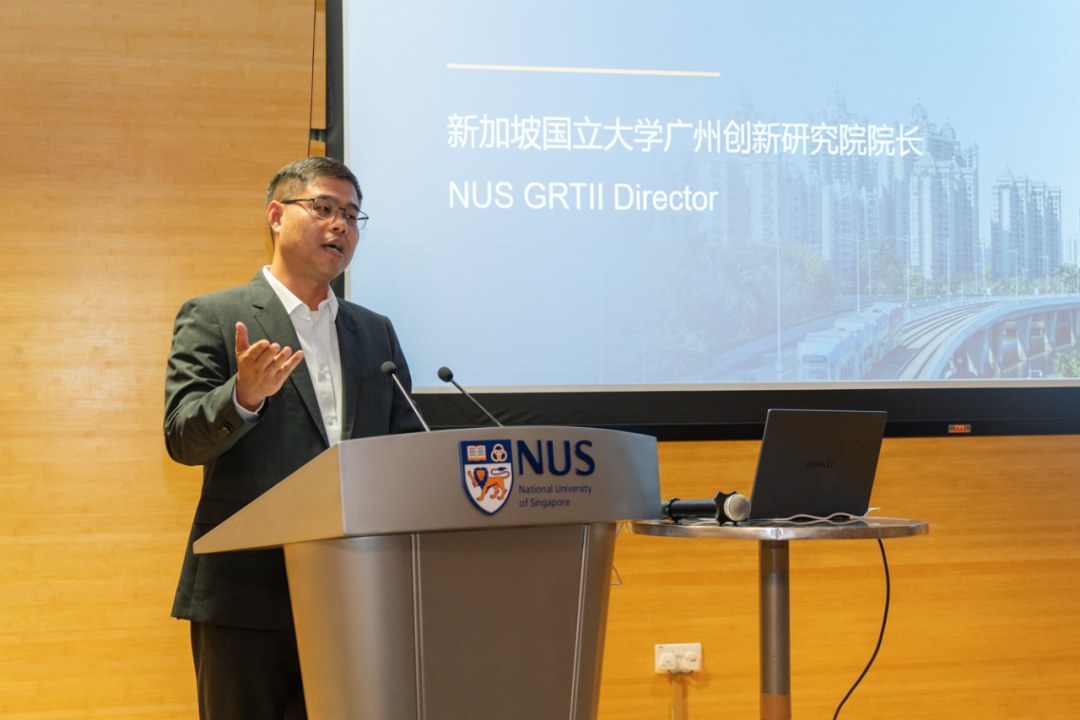
The event commenced with welcoming remarks from Professor Dan Zhao, Director of the NUS (Guangzhou) Research Translation and Innovation Institute. On behalf of the Institute, Professor Zhao extended a warm welcome to all attending faculty and students, while expressing sincere gratitude to the Municipal Government of Guangzhou and the Huangpu District Government for their robust support.
Sharing his personal reflections since assuming the directorship in March, Professor Zhao highlighted the dynamic energy and rich diversity he has experienced firsthand in Guangzhou and Huangpu. He noted that the primary objective of organizing this info session is to bring the rapid development and valuable opportunities of Guangzhou and Huangpu directly to the NUS community, establishing an accessible platform for in-depth engagement and mutual understanding.
As a key strategic vehicle for collaboration in technological innovation and talent development between NUS and Guangzhou and Huangpu, the Institute’s core mission is to bridge NUS’s world-class research expertise and talent base with local industrial demands and innovation resources, thereby creating expanded avenues for exchange and synergy between high-caliber talent and enterprises across both regions.
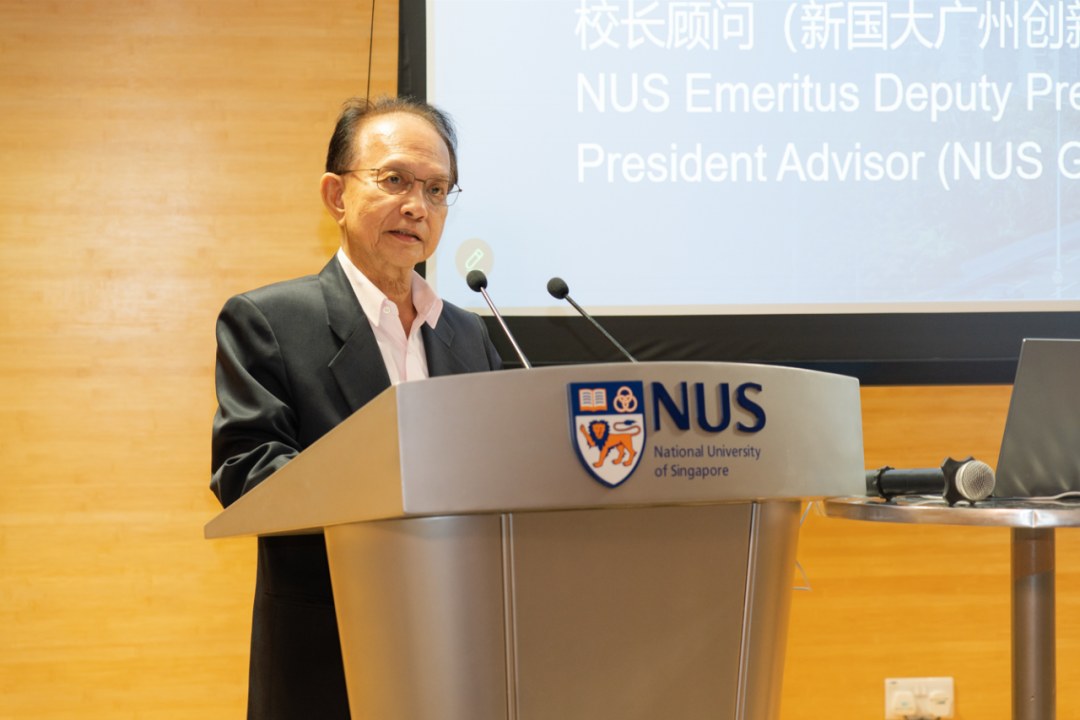
Subsequently, Professor Hang Chang Chieh, Emeritus Deputy President of the National University of Singapore and President Advisor of the NUS (Guangzhou) Research Translation and Innovation Institute, delivered a guest address.
Professor Hang commended NUS for providing an open platform that fosters curiosity and the pursuit of excellence. He encouraged attendees to broaden their horizons, emphasizing that truly impactful innovation occurs not in isolation within laboratories, but at the intersections of diverse disciplines, cultures, and industries.
He highlighted the presence of delegates from the Huangpu District of Guangzhou, who made a dedicated trip to NUS to showcase the region's vibrant industrial ecosystem, advanced research platforms, and thriving technology enterprises. These resources, he noted, offer real-world deployment scenarios essential for translating NUS's research outcomes into practical applications, making the region well worth visiting. To bridge academic research with commercial markets and connect laboratory discoveries to industry, Professor Hang underscored that the NUS GRTII serves as a ready-built conduit.
Whether for seasoned faculty members and veteran researchers, or for students actively mapping out their future pathways, Professor Hang encouraged everyone to cultivate an unbounded mindset—stepping forward to explore emerging markets and gain firsthand insight into evolving industries. He expressed his earnest expectation that more faculty, researchers, and students will leverage the Institute as a catalyst to forge strong, lasting ties with Guangzhou and Huangpu, ultimately allowing their academic expertise and capabilities to deliver tangible value across a broader horizon.
Decoding Huangpu:
A Report Card on an Innovation Hub
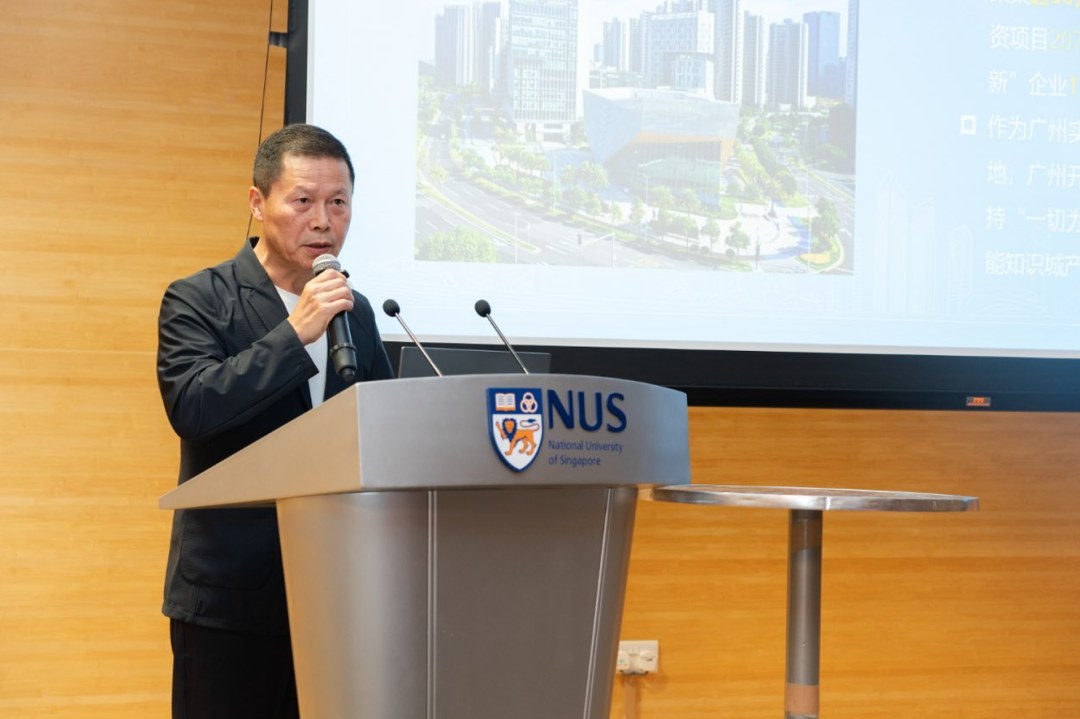
Dr. Datong Wang, Deputy Secretary of the CPC Guangzhou Development District Working Committee, delivered a special presentation introducing the Guangzhou Development District and Huangpu District to the attending faculty and students. In terms of living quality, economic dynamism, educational excellence, lifestyle vitality, and holistic health, Dr. Wang presented a comprehensive panorama of the district's development as the "crown jewel of the Greater Bay Area."
He noted that Huangpu District ranks among the national leaders in core economic indicators among economic and technological development zones nationwide, hosting thousands of national high-tech enterprises alongside highly productive Singapore-Guangzhou collaborative achievements. Furthermore, the district has established a complete educational ecosystem ranging from basic schooling to advanced research platforms, combining a millennium-old cultural heritage with a living environment characterized by "half-green landscapes and half-cityscapes." It is also rapidly integrating into the Greater Bay Area's one-hour commuting circle, with steadily expanding medical and senior healthcare resources. Dr. Wang concluded with a warm invitation to the NUS community: "Go to Huangpu, go to the Knowledge City, share in new development opportunities, and create a better future together!"
Policy Support:
Comprehensive Incentives and Talent Packages
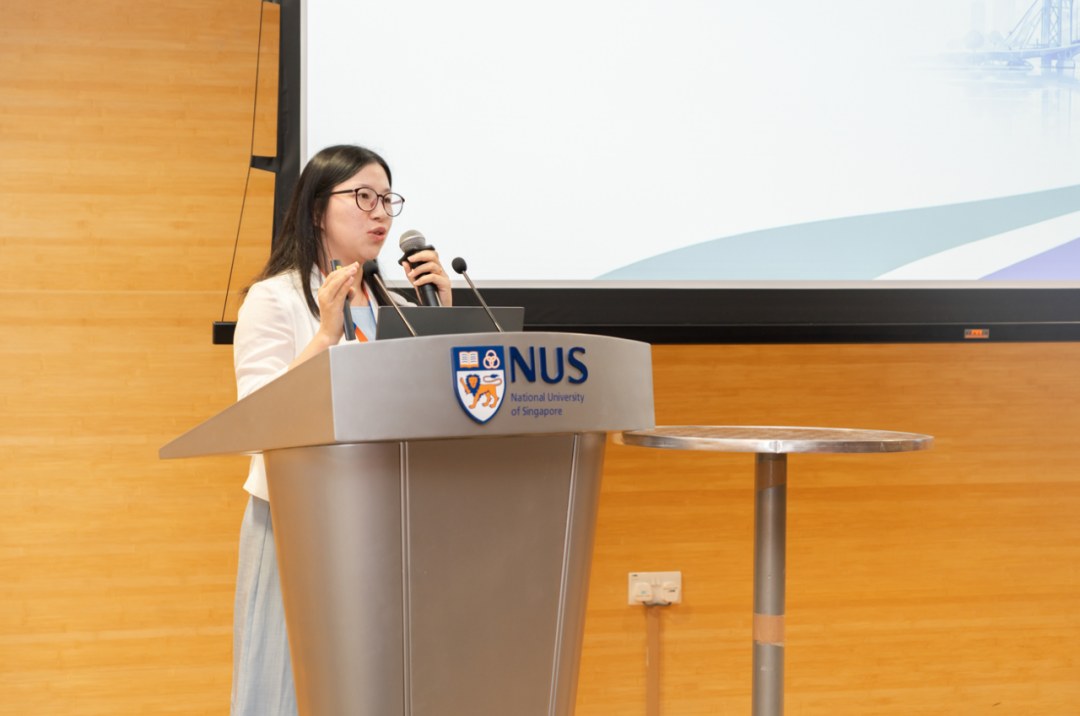
During the talent policy presentation, Ms. Wang Liping, Director of the Human Resources and Administration Office at the NUS (Guangzhou) Research Translation and Innovation Institute, delivered a systematic overview of the multi-tiered talent policy framework across three administrative levels: Huangpu District, Guangzhou Municipality, and the Guangdong-Hong Kong-Macao Greater Bay Area.
The presentation detailed an end-to-end support system covering key areas including housing, household registration, research grants, and living allowances. Key measures feature housing subsidies, home purchase support, postdoctoral research funding, streamlined residency procedures, and coordinated schooling for talents' children. Characterized by substantial financial backing and broad coverage, this robust policy package effectively demonstrated to the attending students Guangzhou and Huangpu’s sincere commitment and strong foundation in attracting top-tier global talent.
Industry Leaders Assemble:
Diverse Pathways to Career Success in Huangpu
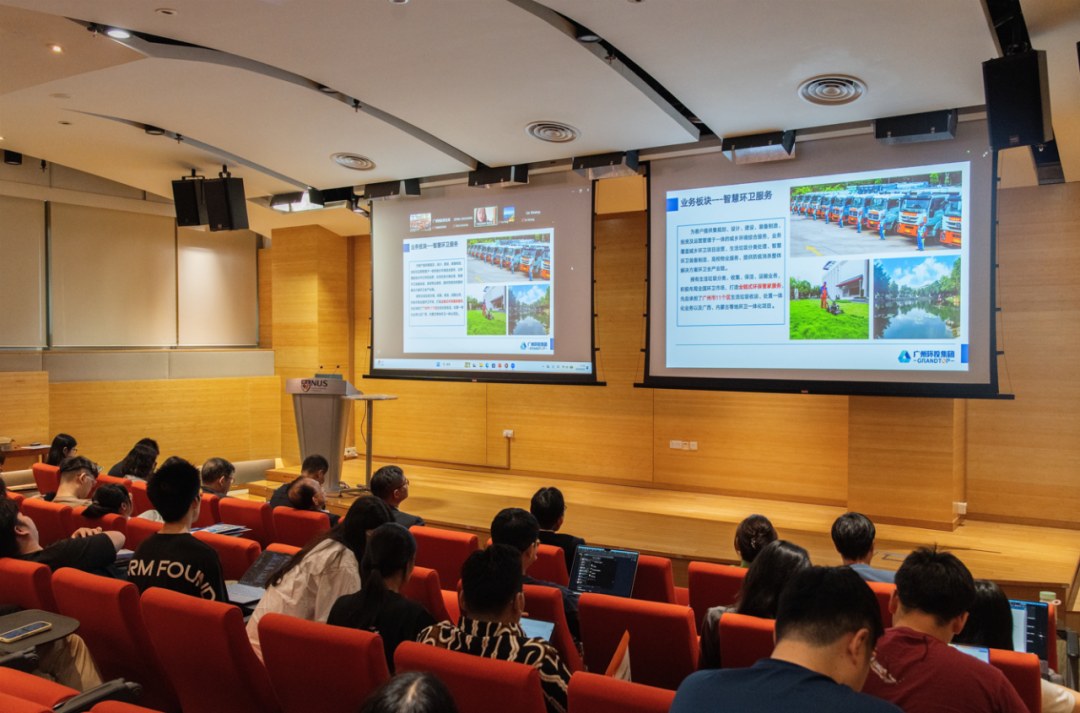
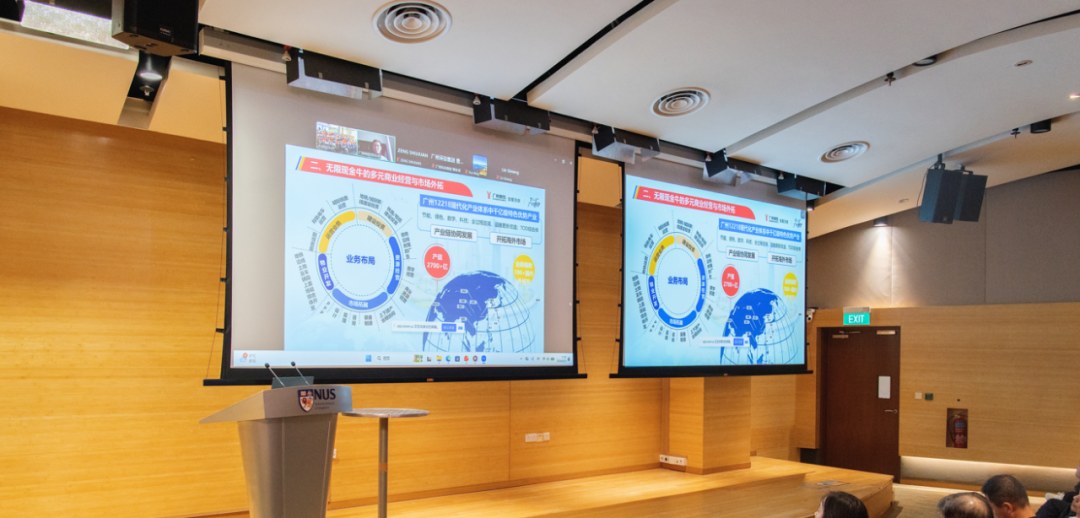
The info session featured a special session highlighting career opportunities at prominent enterprises, bringing leading Guangzhou-based companies together both on-site and online to provide NUS talent with diverse career pathways and real-world employment options.
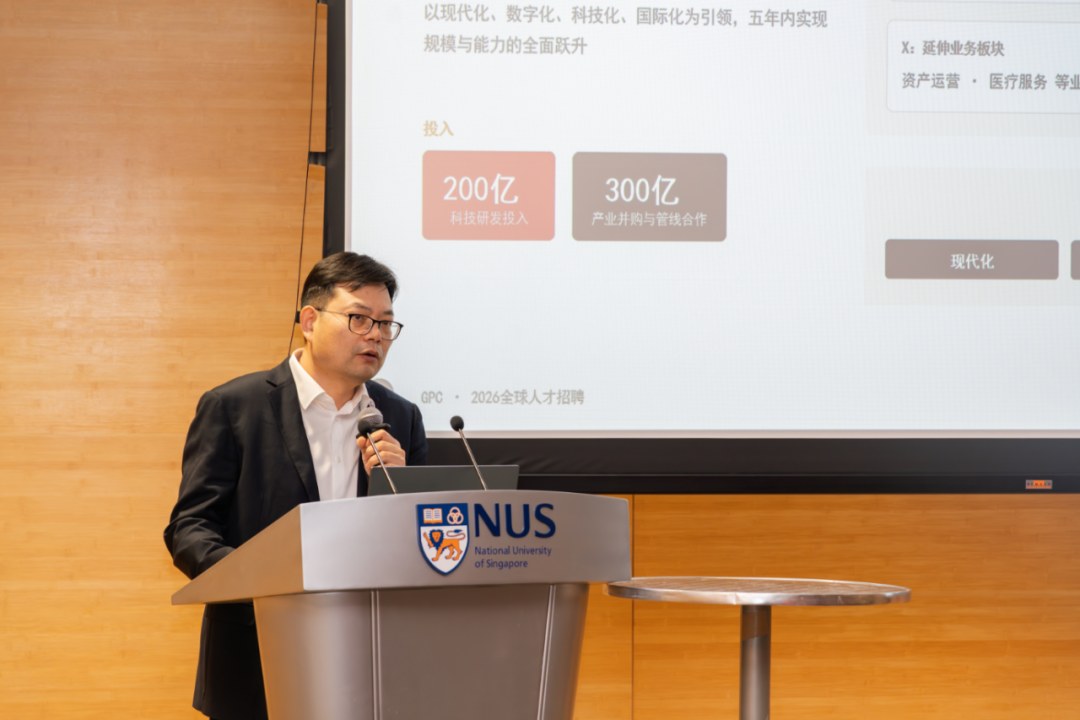
Mr. Yueliang Tao, Director of the Organization Department (Human Resources Department) of the Party Committee of the Guangzhou Pharmaceutical Holdings Limited (GPHL) and Deputy Secretary of the Party Committee of Guangzhou Baiyunshan Pharmaceutical Holdings Company Limited (GYBYS) attended the event in person. He presented the century-old pharmaceutical leader's strategic layout and talent requirements across the biopharmaceutical and healthcare sectors, extending a warm invitation to NUS students to join the career expanse of this "pharmaceutical powerhouse."
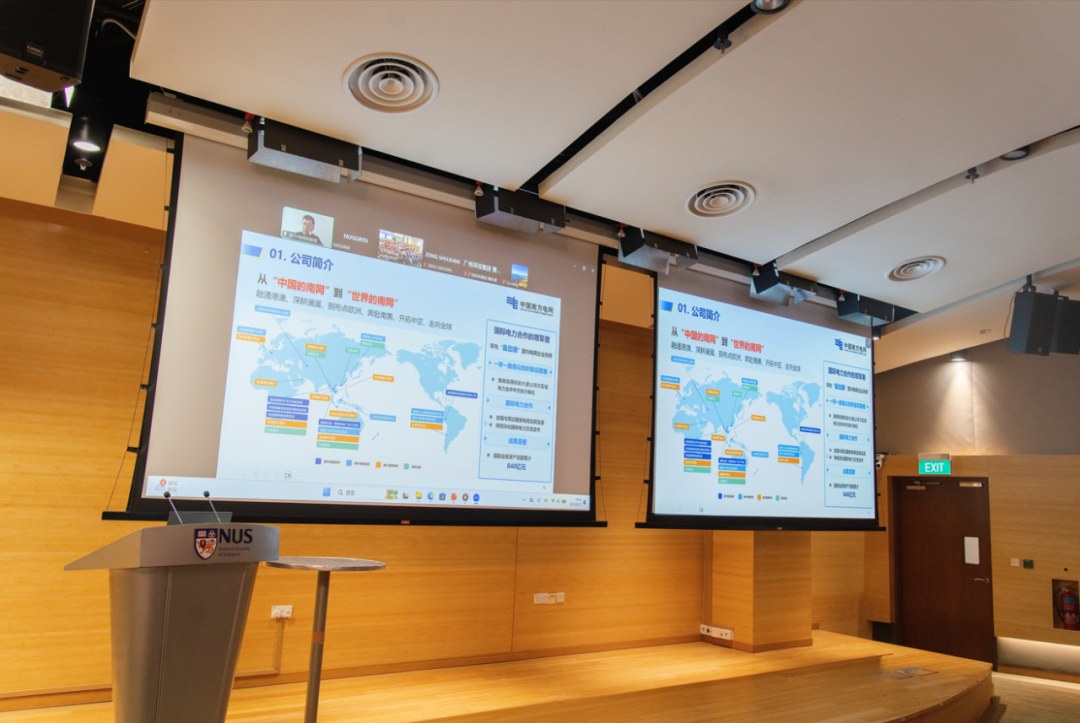
Three leading state-owned enterprises—China Southern Power Grid Co., Ltd. (CSG), Guangzhou Metro Group Co., Ltd. and Guangzhou Environmental Protection Investment Group Co., Ltd.—joined the presentation session virtually. Mr. Liu Chengjia, Head of the Talent Workstation of Shenzhen Power Supply Bureau Co., Ltd., Mr. Wu Xianqi, Senior Supervisor of the National Engineering Research Center under Guangzhou Metro Group Co., Ltd., and Ms. Cao Yizhuo, Officer of the Human Resources Department of Guangzhou Environmental Protection Investment Group Co., Ltd., showcased the expansive platforms and structured career growth pathways offered by Guangzhou's public sector across the energy, urban rail transit, and green environmental sectors.
A Single Info Session
Redefining "Huangpu" in Participants’ Eyes
During the info session, several attending faculty members and students shared their impressions of the event. Associate Professor Feng Mengling, Associate Director of Research at the NUS Institute of Data Science (Healthcare), Associate Professor at the Saw Swee Hock School of Public Health, and Principal Investigator at the NUS (Guangzhou) Research Translation and Innovation Institute, shared his insights:
"Today has given me a fresh perspective on Huangpu District, along with a clear view of the expansive opportunities it offers to research teams and young scholars. Artificial intelligence is our research team's core strategic priority for the next five years, and Huangpu's robust, well-established industrial ecosystem can provide our PhD students with abundant, highly compatible research and career opportunities. Many students studying in Singapore focus heavily on academic research and have limited exposure to the domestic industry environment, particularly Huangpu's enterprise ecosystem. I hope the Institute will continue to host such seminars to bridge the gap between universities and industry, giving students opportunities to intern at premier enterprises in Huangpu, gain practical experience, and broaden their future career choices and research collaborations."
The attending students shared equal enthusiasm, expressing their strong expectations and readiness to pursue future development opportunities in Huangpu.
"Previously, my perception of Huangpu was limited to tourism. Through this dedicated info session, I discovered that Huangpu not only offers top-tier platforms and opportunities for research translation, but also opens up high-quality employment positions across diverse sectors—such as power grids, environmental protection, and urban rail transit—for doctoral graduates. Its comprehensive talent policy framework gives me immense confidence and optimism about my future career development. I am particularly impressed by Huangpu's 'dual-track' career structure combining technical expertise and management. I believe this model breaks the traditional developmental limitations faced by researchers, opening up entirely new pathways and insights for career progression in research."
— Student Xia, PhD Candidate, Department of Built Environment, College of Design and Engineering, NUS
"Prior to attending this seminar, I had always assumed that Huangpu was geographically somewhat remote. However, through the detailed presentations by the speaker panel, I gained a true appreciation of how the Greater Bay Area—and Huangpu in particular—leads the country in technological innovation investment and industrial development. For students like me who are committed to long-term scientific research, Huangpu represents a high-potential platform brimming with exceptional opportunities. I have already set my personal plans to actively engage with premier local enterprises in Huangpu and submit my applications before graduation, with the goal of establishing my career and long-term future here."
— Student Liu, PhD Candidate, Department of Civil and Environmental Engineering, College of Design and Engineering, NUS
"During this info session, I paid close attention to how Huangpu's talent policies align with career opportunities for high-level talent. The incentive programs, such as settling-in allowances and home purchase subsidies, are benefits I eagerly look forward to. My research focuses primarily on optical imaging, and while I have not yet identified a role that perfectly matches my exact specialization, the seminar provided me with a much clearer, more concrete, and comprehensive understanding of Huangpu's overall industrial scale, strategic layout, and academic ecosystem. I am confident that Huangpu's well-established industrial framework and rich array of talent platforms will match highly educated professionals with fitting roles, enabling us to fully apply our academic expertise."
— Student Bao, PhD Candidate, Department of Biomedical Engineering, College of Design and Engineering, NUS
Grounded in the Greater Bay Area, Connecting China and Singapore, Reaching Global Horizons
As the flagship platform of the National University of Singapore participating in the construction of the Guangdong-Hong Kong-Macao Greater Bay Area, NUS GRTII remains steadfastly committed to facilitating international research translation, fostering two-way talent mobility, and supporting regional industrial upgrading. This seminar brought the dynamic growth and career opportunities of Guangzhou and Huangpu directly to NUS, establishing an efficient bridge between young Chinese and Singaporean talents and the industrial demands of the Greater Bay Area.
Looking ahead, the institute will continue to leverage NUS's world-class research excellence and mature innovation ecosystem, maximizing its unique advantage as a cross-border innovation conduit between China and Singapore. By joining forces with NUS’s global research teams, leading domestic and international universities, and industry powerhouses in the Greater Bay Area, NUS GRTII aims to accelerate the concentration of high-caliber talent and the commercialization of cutting-edge technologies, empowering the Greater Bay Area to build a world-class industrial center and a premier talent reservoir for innovation.