Associate Professor David Leong Tai Wei, Principal Investigator (PI) at NUS Guangzhou Research Translation and Innovation Institute (NUS GRTII), Associate Professor from the Department of Chemical and Biomolecular Engineering, National University of Singapore (NUS), and his team published a breakthrough study in the journal Cell, pioneering the LEAF (Light-reaction Enriched thylAkoid NADPH-Foundry) photosynthetic therapy system. Under ordinary indoor lighting, LEAF continuously synthesises the anti-inflammatory molecule NADPH, significantly repairing corneal damage within five days with efficacy surpassing existing mainstream drugs, and has completed a two-month safety assessment. This "light-as-medicine" cross-disciplinary approach requires no external devices and acts non-invasively using only ambient light, offering a novel treatment pathway for over 1.5 billion dry eye disease patients worldwide and opening prospects for bioenergetic regulation in tissues such as the retina and skin. The team has initiated follow-up clinical trials to accelerate clinical translation.
What if your eyes could use light to heal themselves?
Drawing inspiration from how plants harness sunlight, Associate Professor David Leong Tai Wei and his team at the National University of Singapore (NUS) are pioneering a revolutionary treatment for dry eye disease. Their approach uses a light-activated technology derived from the photosynthetic membranes of the spinach plant, enabling the eye to stay continuously hydrated. This offers a solution that is simple, effective and non-invasive.
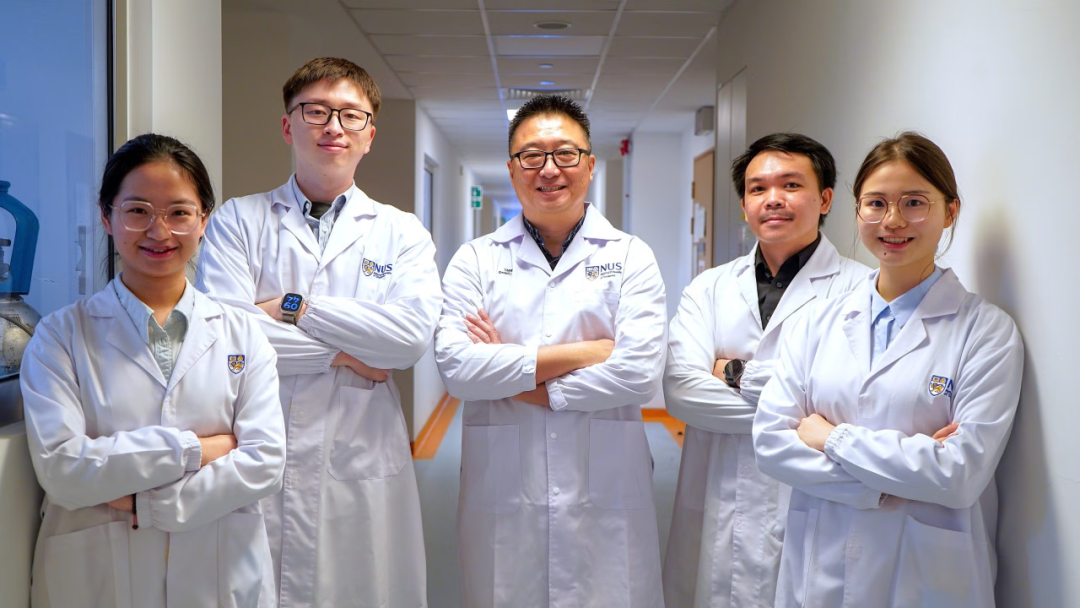
(From left to right: Ms Chen Yinglu, Dr Xing Kuoran, Associate Professor David Leong, Mr Glebert Cañete Dadol, Ms Tong Siye)
Assoc Prof Leong and his NUS team extracted and transplanted the plant machinery responsible for photosynthesis into the eye's corneal cells via eye drops to treat dry eye disease.
Dry eye disease, also known as keratoconjunctivitis sicca, is one of the most common eye conditions, affecting more than 1.5 billion people worldwide. Far more than a minor discomfort, the disease causes corneal scarring, chronic pain, blurred vision and sensitivity to light. Various studies have linked it to depression, anxiety and reduced workplace productivity, as well as an economic burden estimated at US$3.84 billion annually in the United States alone.
Current treatments such as cyclosporine A (Restasis®) and lifitegrast (Xiidra®) target inflammation through specific molecular pathways, but their high costs and adverse side effects limit long-term use.
At the cellular level, the disease is driven by a vicious cycle. Inflammation in the corneal region generates reactive oxygen species (ROS), chemically aggressive molecules that damage cells. Healthy eyes can neutralise ROS through antioxidant production that is driven by Nicotinamide Adenine Dinucleotide Phosphate (reduced form) (NADPH). But in inflamed eyes, ROS levels overwhelm the cornea's natural defences, resulting in the generation of even more ROS – a death spiral.
A team led by Associate Professor David Leong Tai Wei from the Department of Chemical and Biomolecular Engineering in the College of Design and Engineering at NUS has developed a fundamentally different approach by transplanting functional plant-derived photosynthetic machinery into corneal cells, enabling them to harvest ambient light and produce NADPH independently from the cells' own NADPH production pathways. In preclinical studies, the technology, delivered as simple eye drops at doses so low that it does not interfere with colour perception, reversed corneal damage to near-healthy levels within five days, outperforming Restasis®.
The study was published online in the scientific journal Cell on 15 May 2026.
An eye-opening biological crossover
Evolutionarily, plants and animals have taken divergent paths such that animals, with one exception, are not able to photosynthesise. This exception is the sacoglossan sea slug, which ingests and stores away the chloroplasts (organelles responsible for photosynthesis in plant cells) of microalgae within its intestinal cells. When starved, these sea slugs can live off the nutrients made through photosynthesis — the only known case of an animal being able to photosynthesise just like a plant. This unusual animal trait raised an intriguing question: could mammals also acquire some limited form of photosynthesis?
To test out their ideas, Assoc Prof Leong and his team chose the eye as it is one of the few organs in the human body that absorbs visible light — just like plant leaves. They engineered LEAF (Light-reaction Enriched thylAkoid NADPH-Foundry), a nanosized, structurally preserved version of the thylakoid grana — the tightly stacked membrane compartments inside the chloroplasts of plant cells where light energy is harnessed and converted to NADPH molecules. During photosynthesis, the NADPH molecules are subsequently used to produce glucose, providing energy and food for the plant.
The team's core innovation was to strip away the part of the chloroplasts that consumes NADPH while keeping the thylakoids, where the light-reactions machinery of photosynthesis is, intact. This resulted in a nanosized package that acts as a dedicated NADPH factory capable of producing about 20 per cent more NADPH compared to unpackaged thylakoids. Prepared from the familiar spinach leaves using a patented, mild mechanical and chemical extraction method developed by the NUS team, the particles are roughly 400 nanometres across — small enough to be readily absorbed by cells. LEAF, when in the cells, then produces photosynthetic NADPH upon exposure to ambient light sources, and the NADPH produced tackles dry eye disease via two pathways – inside and outside the cell.
"This is an exciting finding as we have, for the first time, demonstrated that plant photosynthetic machinery can be transplanted into mammalian tissue to generate biologically useful molecules, powered entirely by the same light that enables our vision. We, too, can have limited photosynthetic abilities." said Dr Xing Kuoran, the first author of the work.
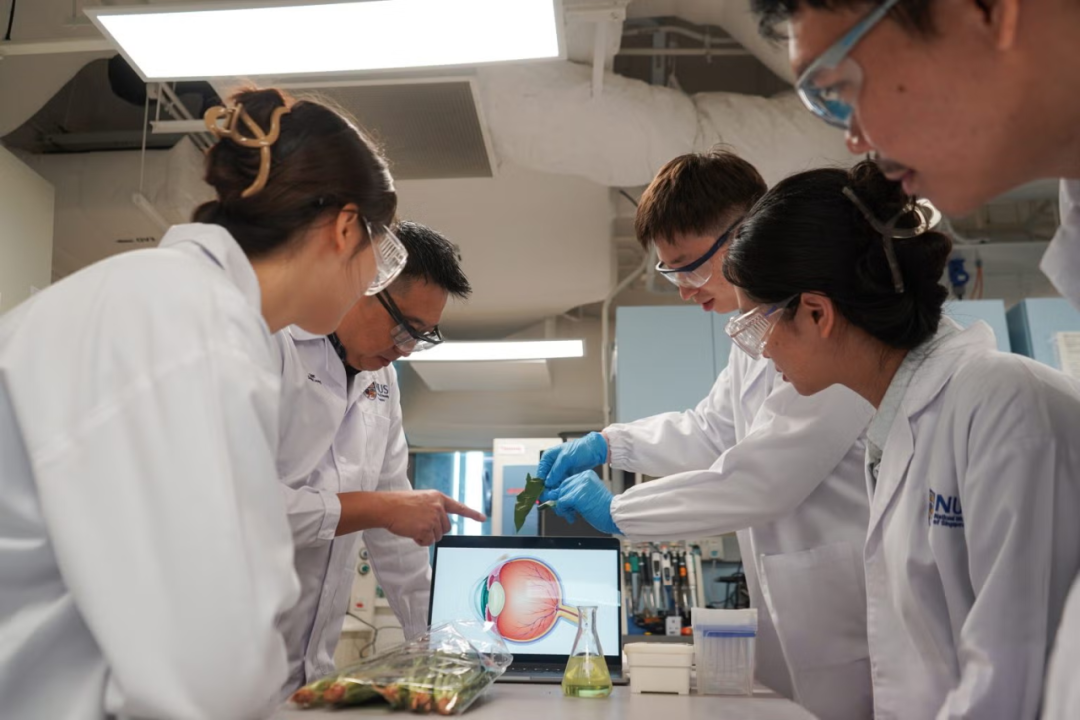
The NUS team developed a patented method that gently extracts the thylakoid grana from the cells of the spinach plant and used it as the active ingredient in their eye drops. In preclinical studies, the novel eye drops created by the team outperformed Restasis®, an existing treatment for dry eye disease.
Tested in living tissue
In laboratory tests on inflamed cells, LEAF restored NADPH levels within 30 minutes of light exposure, suppressed ROS and pivoted immune cells in the cornea from a pro-inflammatory to an anti-inflammatory state. When tested directly in tear samples collected from patients with dry eye disease, LEAF increased NADPH levels roughly 20-fold and reduced hydrogen peroxide, a key cell-damaging oxidant, by more than 95 per cent.
In their first preclinical trial in collaboration with ophthalmologists from Eye Centre of Second Affiliated Hospital, Zhejiang University, LEAF administered as eye drops under ambient indoor lighting reversed corneal damage to near-healthy levels within five days, outperforming Restasis®. A second preclinical trial also confirmed the therapeutic effect. Safety assessments, including skin sensitisation, eye irritation and organ toxicity studies conducted over two months showed no adverse effects. The team plans to conduct clinical trials to further validate the technology.
More than meets the eye
"With LEAF, we now have a technology that harnesses ambient light to directly restore the molecule that dry eye disease depletes," added Assoc Prof Leong. "As it is derived from spinach, delivered as a simple eye drop, requires no external device or power source and using the ambient light that is used for vision, we believe it has a strong potential for clinical translation. It is almost surreal when thinking of a possible future reality where human cells can have some limited but beneficial form of photosynthetic ability not only in the eye but elsewhere, too."
In addition, as oxidative stress underpins a wide range of inflammatory conditions beyond dry eye disease, the team also sees potential for LEAF-based approaches wherever the body's antioxidant defences are overwhelmed, particularly in tissues naturally accessible to visible light such as the retina, skin and underlying skeletal muscles. They are also developing new strategies that can produce therapeutically useful photosynthesised molecules in internal organs without the need for visible light penetration.