Recently, Boeing and NUS Enterprise announced the results of the inaugural Boeing University Innovation Leadership Development Program (BUILD). Among nearly 100 submissions and 10 finalist teams, the UrbanFlow team—led by Assistant Professor Ang Yu Qian from the Department of Architecture, NUS College of Design and Engineering, and Principal Investigator at the NUS Guangzhou Research Translation and Innovation Institute (NUS GRTII), together with NUS GRTII PhD Scholarship recipient Xia Ye and other collaborators—was selected as one of the three winning teams of the program.
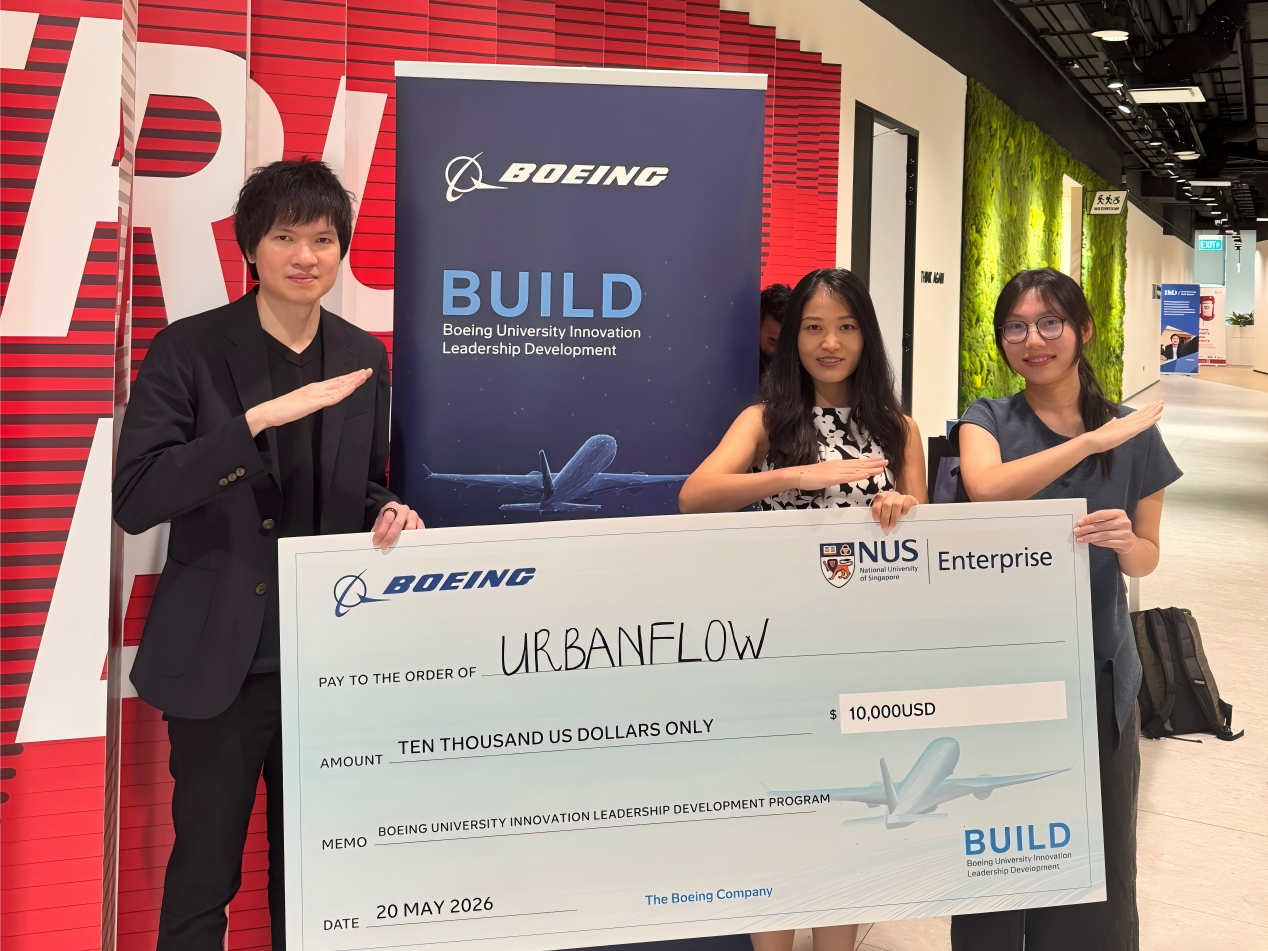
The BUILD program, jointly launched by Boeing and NUS Enterprise, is an international innovation and leadership initiative designed to foster aerospace-related innovation, entrepreneurial capability, and technology translation. Through innovation bootcamps, mentorship from industry experts, and pitch presentations, the program aims to help research-driven teams identify real-world applications of emerging technologies in the aerospace sector.
UrbanFlow: Agentic AI-Enabled Sustainable Design and Industrial Innovation
UrbanFlow builds on years of research led by Assistant Professor Ang Yu Qian in urban analytics and computational urban design. Developed within NUS's research and innovation ecosystem, it has grown into one of the flagship innovation projects.
It integrates artificial intelligence, physics-based simulation, machine learning, geospatial intelligence, and autonomous AI agents (Agentic AI) to rapidly evaluate and optimize design solutions related to energy consumption, carbon emissions, construction cost, and climate performance. It provides real-time, data-driven decision support for design and planning teams.
During the BUILD program, the team focused on optimizing energy efficiency and spatial planning for aerospace ground infrastructure, exploring the potential of UrbanFlow in aerospace and industrial facility management scenarios. The project demonstrated the effectiveness of Agentic AI in complex industrial decision-making environments and received strong recognition from the judging panel.
NUS GRTII PhD Scholarship recipient Xia Ye played a key role in the project, contributing to system development, solution optimization, and project presentation, while working closely with the team on validation and application exploration in aerospace-related scenarios.
Bridging Research and Industrial Applications
This recognition further validates the cross-sector applicability of the UrbanFlow platform beyond architecture and urban design.
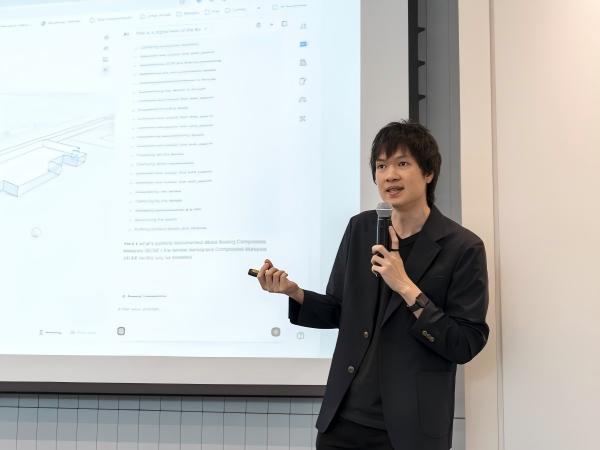
Assistant Professor Ang Yu Qian commented: "This recognition further demonstrates the potential of UrbanFlow in supporting data-driven and sustainable design decisions. It is not only applicable to architecture and urban systems, but also to complex industrial domains such as aerospace."
He further noted that the team will continue advancing research on UrbanFlow's applications across architecture, urban systems, and industrial facilities, while further enhancing its capabilities in Agentic AI and intelligent simulation. The team also plans to explore potential pilot collaborations with Boeing to investigate how intelligent analytics and digital decision-making tools can help facility management teams improve operational efficiency, identify energy-saving opportunities, and optimize carbon and energy management.
Advancing Innovation and Entrepreneurship Ecosystems
The UrbanFlow is rooted in the research and innovation ecosystem of the National University of Singapore (NUS) and has been supported by initiatives such as the NUS Graduate Research Innovation Programme (NUS GRIP). It has also been selected for global startup support programs including Microsoft for Startups and the NVIDIA Inception Program.
This award not only highlights the innovation strength of Assistant Professor Ang Yu Qian's team in Agentic AI and sustainable design, but also demonstrates UrbanFlow's strong potential in enabling data-driven decision-making and cross-industry applications. Moving forward, the team will continue to advance the integration of artificial intelligence, digital twins, and sustainable design technologies, contributing to low-carbon development and smart city innovation.
City Syntax Lab – Overview
Lab Head:
Assistant Professor Ang Yu Qian
Core Philosophy: Reimagining Space through "Syntax"
Inspired by linguistics, the lab's research is grounded in three foundational concepts: Structure, Connection, and Meaning.
Decode: Leveraging artificial intelligence, scientific methodologies, and policy analysis to uncover the hidden rules of urban evolution.
Rewrite: Identifying key leverage points within urban networks and transforming fragmented data and infrastructure into meaningful human environments.
Multi-Scale Research Approach
The lab investigates urban systems across multiple scales:
Macroscopic urban scale: Optimizing urban mobility and analyzing the interdependence between buildings, transportation systems, and public spaces.
Microscopic architectural scale: Studying the impact of architectural design on human thermal comfort and environmental performance.
Technological Drivers of Transformation
Beyond theoretical frameworks, the lab translates its "shared syntax" into actionable tools:
UrbanFlow: An AI-driven urban design platform enabling intuitive, data-informed spatial decision-making.
Buildings.SG: A carbon footprint mapping tool for building clusters in Singapore, supporting data-driven sustainable transformation.