A research team led by Professor Benjamin Tee, Principal Investigator at the National University of Singapore Guangzhou Research Translation and Innovation Institute and Professor in the Department of Materials Science and Engineering at NUS, has developed a fully mechanical soft force sensor known as ME-SOFS.
The device eliminates the need for electronic circuits, external power supplies and computational chips. Using only mechanical and fluidic structures, it can detect touch and directly trigger robotic actions, giving soft robots sensing and response capabilities similar to instinctive biological reflexes. The research was published in the internationally renowned journal Science Advances on 8 July 2026. The paper was co-led by Professor Benjamin Tee from the Department of Materials Science and Engineering and Professor Cecilia Laschi from the Department of Mechanical Engineering. Dr Yu Kelu, Research Fellow from the Department of Materials Science and Engineering, served as co-first author.
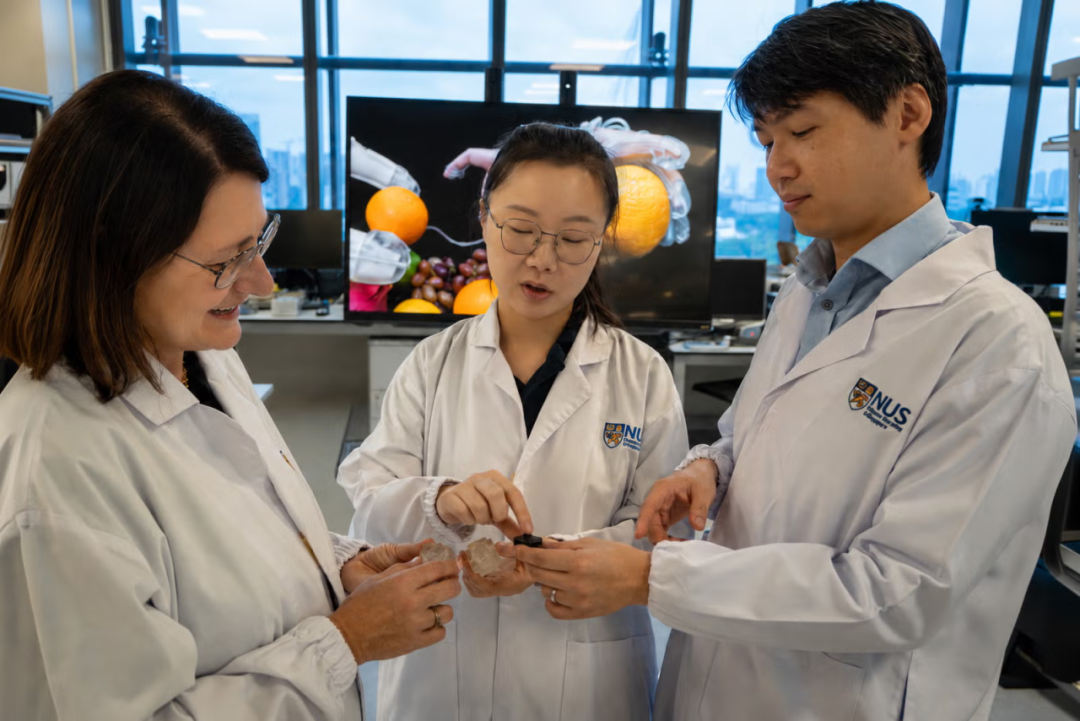
From left to right: Professor Benjamin Tee, Dr Yu Kelu, and Professor Cecilia Laschi.
Stable Operation in Extreme Environments with Tunable Sensitivity for Diverse Applications
The key breakthrough of ME-SOFS lies in its fully passive sensing-to-actuation loop. Unlike conventional robotic systems that rely on electronic sensors to convert external stimuli into electrical signals before processing and control, ME-SOFS directly converts applied forces into fluidic pressure, enabling immediate actuation without electronic signal processing or external energy sources.
The sensor demonstrates strong environmental robustness beyond conventional electronic sensors. It maintains stable performance in hot water at 90°C and under high-pressure conditions equivalent to approximately 11 metres underwater. Since it contains no electronic components, it is also immune to electromagnetic interference and avoids common electronic failures such as short circuits and malfunction under harsh conditions.
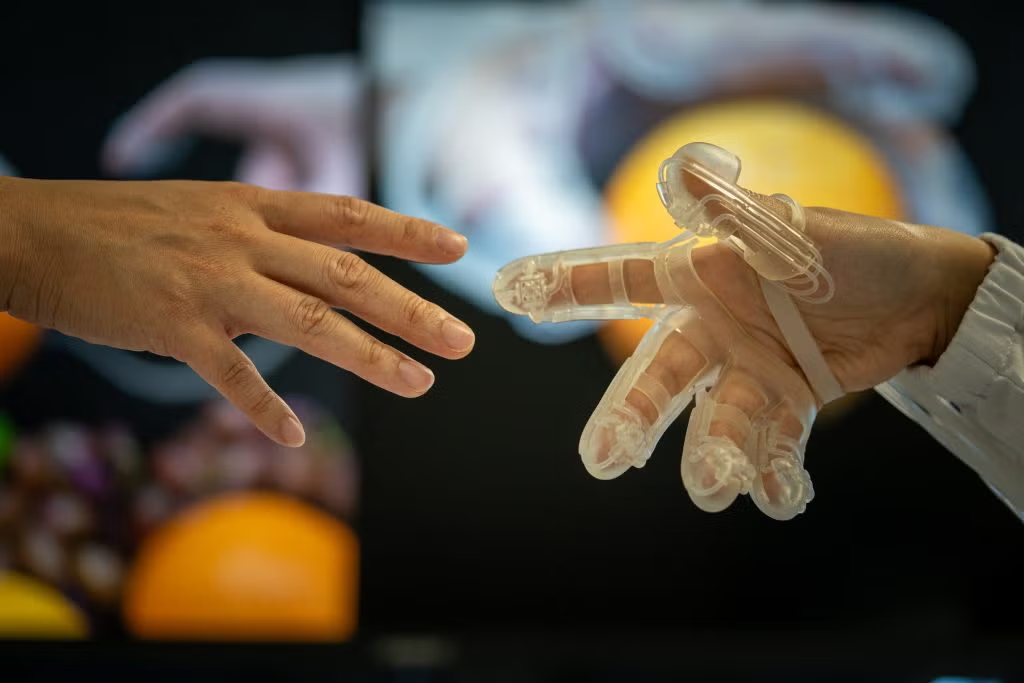
The sensitivity of ME-SOFS can also be widely tuned by modifying geometric parameters in its 3D-printed design, including pore diameter, slope thickness and slope angle of the central structure. By adjusting these parameters, researchers can customise the sensor’s response characteristics for different applications, while also adapting its size, material composition and porous architecture.
By simplifying the sensing and actuation architecture of soft robots, this technology could enable robotic systems capable of operating in challenging environments such as high-temperature industrial pipelines and deep-sea exploration, while opening new possibilities in medical training, prosthetics and human–machine interaction.
Mimicking Biological Reflexes: How a Purely Mechanical Fluidic Structure Enables Tactile Perception
Soft robots are becoming increasingly flexible and adaptable, with potential applications ranging from minimally invasive surgery to deep-sea exploration. However, their reliance on conventional electronic sensing systems remains a major limitation. Traditional soft robotic platforms typically require separate electronic sensors, signal-processing circuits and powered actuators. These additional components increase system complexity, weight and potential failure points, particularly in wet, hot or high-pressure environments where electronics are vulnerable.
Inspired by biological systems, Professor Tee and Professor Laschi’s team explored whether fluid-based structures could simultaneously achieve tactile sensing and force feedback without relying on conventional electronic circuits. In nature, many organisms rely on fluid-rich cellular structures to achieve distributed sensing and adaptive responses. Inspired by this principle, the researchers developed a mechanical architecture where sensing and actuation are directly connected through fluidic interactions.
ME-SOFS is fabricated as a flexible porous structure through a single 3D-printing process. At its core is a deformable central pillar connected to five fluid-filled chambers — four arranged horizontally and one vertically. When an external force is applied, the central pillar tilts towards the direction of the force, compressing the corresponding fluid chamber. The displaced fluid then travels through soft tubing to actuators at the other end, directly generating mechanical movement. Because each chamber responds independently, the sensor can distinguish forces along three dimensions: horizontal, lateral and vertical directions.
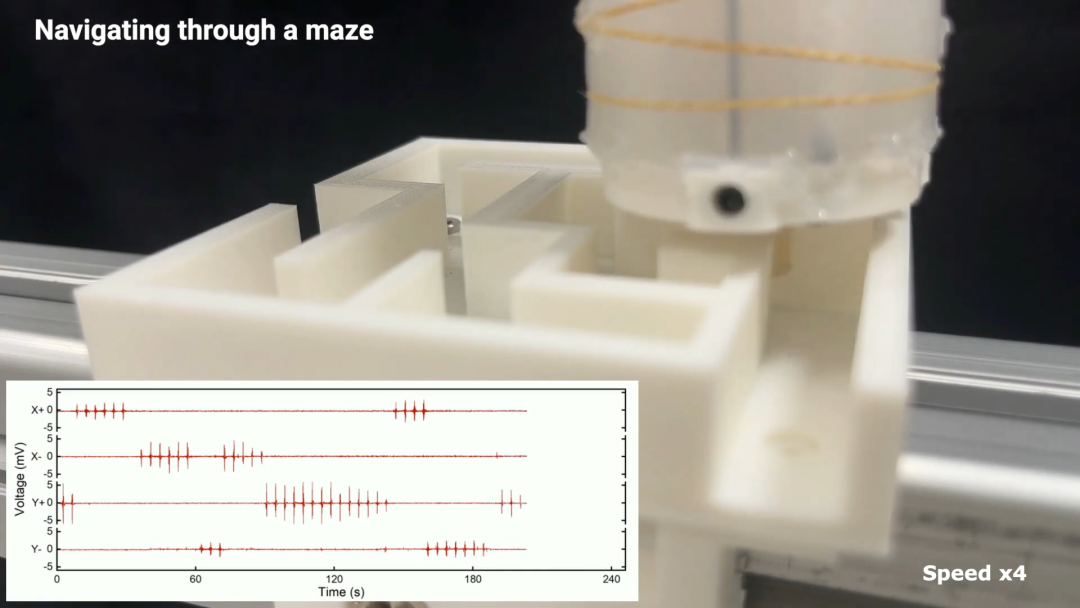
The entire process occurs without electronic conversion between sensing and actuation. Mechanical input is directly transformed into fluid movement, which then produces physical output. To generate measurable force information, the researchers further incorporated a passive sensing circuit. As displaced fluid moves miniature magnets through 3D-printed metallic arcs, changes in magnetic flux generate voltage pulses through electromagnetic induction — similar to the operating principle of a bicycle dynamo. The number of pulses corresponds directly to the amount of fluid displacement and therefore reflects the magnitude of the applied force, allowing force measurement without powered electronics.
Professor Cecilia Laschi noted that the system demonstrates how the physical body itself can generate sensory-motor behaviour without requiring a separate control system.
This form of embodied intelligence, where intelligence is embedded directly within the mechanical structure of the body, is widely observed in nature and provides a new direction for developing more autonomous soft robots.
Demonstrating Applications in Prosthetics, Teleoperation and Portable Medical Devices
To demonstrate the versatility of ME-SOFS, the research team integrated the sensor into several robotic platforms. Using a single-material, continuous 3D-printing process without manual assembly, the researchers fabricated a soft robotic glove embedded with five miniaturised ME-SOFS units, each approximately 1 cubic centimetre in size. When worn on the hand, the glove can detect grasping forces at individual fingertips and estimate the weight of held objects, highlighting its potential for applications in smart prosthetics and human–machine interfaces.
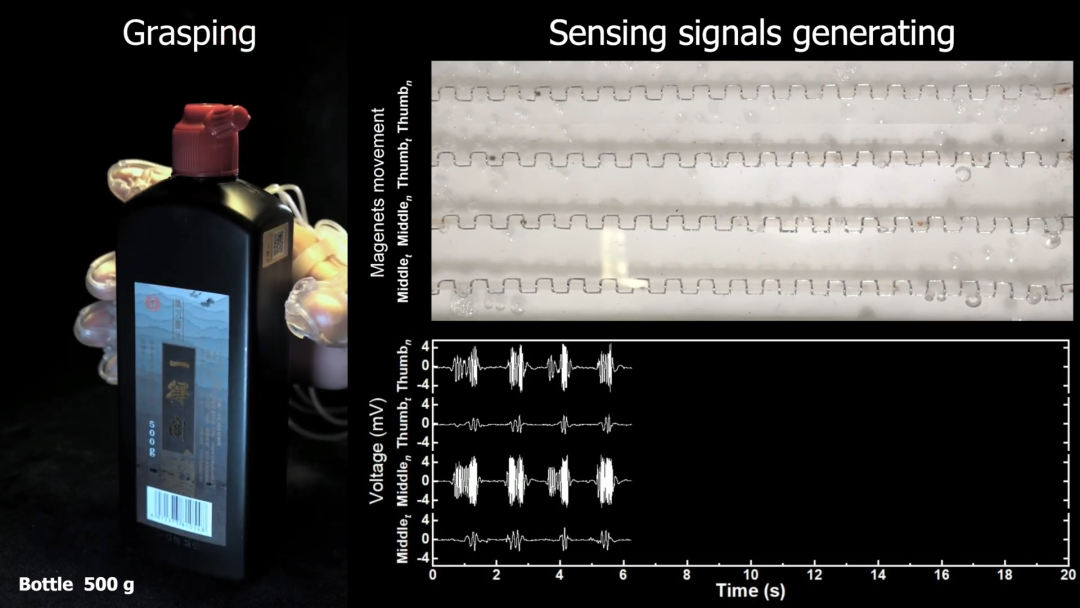
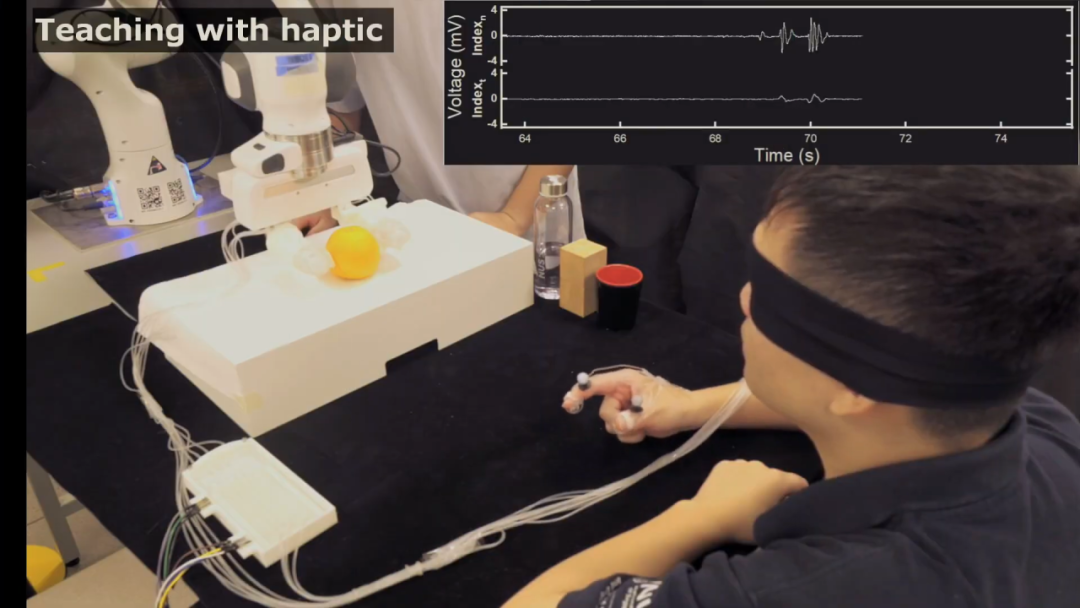
The team also developed a tactile feedback system by connecting ME-SOFS with a soft fingertip haptic pad. During experiments, a human operator wearing a blindfold controlled a robotic arm solely through tactile feedback. The gripping force detected by the robotic gripper was transmitted through fluid pressure to the fingertip pad, allowing the operator to distinguish different objects, including eggs, wooden blocks and partially filled water bottles.
The system was also able to record fluidic signals generated during successful grasping actions. By replaying these recorded signals, the researchers demonstrated that robots could learn and reproduce manipulation behaviours autonomously.
The fluidic transmission system achieved low latency, with a delay of approximately 30 milliseconds through a 3-metre tube and 160 milliseconds through a 15-metre tube, demonstrating its potential for high-precision remote tactile control.
Beyond robotic manipulation, the same sensing-to-actuation architecture was used to control the movement of individual liquid droplets without software-based control, suggesting potential applications in portable medical diagnostic devices.
The system was also able to drive hair-like flexible structures that bend according to the direction and magnitude of detected forces.
Towards Intelligent Soft Robots with Built-in Mechanical Intelligence
During extreme-condition testing, ME-SOFS maintained reliable performance because its open-ended fluidic channels automatically balanced surrounding water pressure. As a result, the sensor responds only to externally applied forces rather than changes in environmental pressure. This unique capability enables potential applications in environments where conventional electronic sensors struggle, including deep-sea exploration and high-temperature industrial inspection.
By integrating sensing, feedback and actuation into a single passive fluidic system, ME-SOFS lowers the barrier for intuitive human–robot interaction. Operators can teach robots through natural tactile experiences rather than complex programming, opening new possibilities in industrial training, remote operation and immersive virtual reality systems.
Moving forward, Professor Tee, Professor Laschi and their collaborators will continue to explore the potential of this technology by further miniaturising the sensor and expanding its actuation capabilities to support a wider range of applications.
When sensing, feedback and action can be achieved through mechanical and fluidic intelligence alone, the robot’s body itself becomes an intelligent platform — bringing soft robotics closer to the adaptive capabilities found in nature.
Information Source: https://cde.nus.edu.sg/news/soft-sensor-developed-by-nus-cde-researchers-turns-touch-into-robotic-action-without-electronics/